Morphological Clues To The Stability Of Wet Piles
5 January 2009, 16:57
Categories: coatings gels--foams
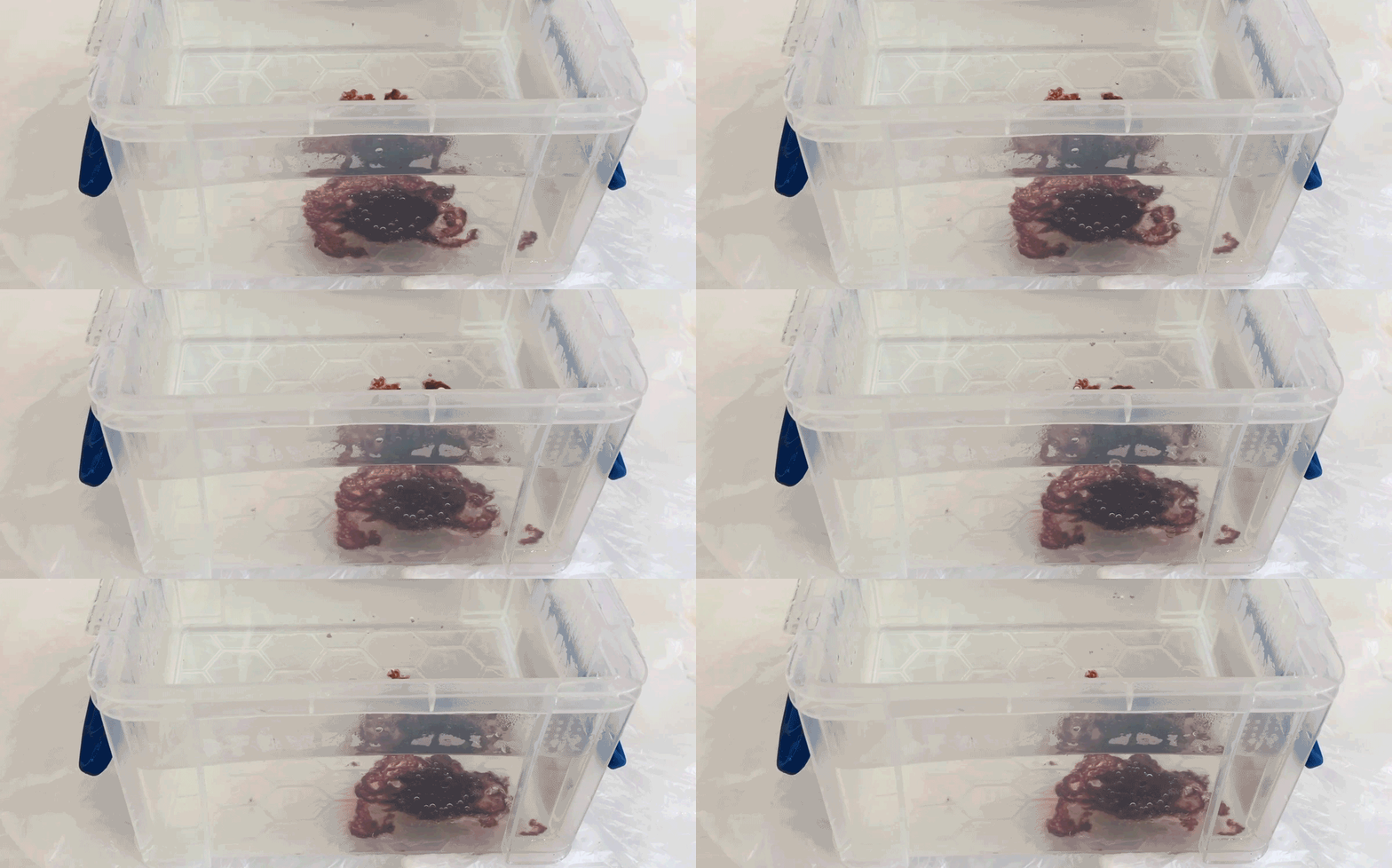
When a granular material is mixed with a certain amount of liquid, the surface tension of the latter bestows considerable stiffness to the material, which enables, for example, sand castles to be sculpted. A group of international researchers from the Max Planck Institute, the European Synchrotron Radiation Facility, the Australian National University, and the Universität Erlangen-Nürnberg, have found that the geometry of the liquid interface within the granular pile is of extraordinary complexity and strongly varies with the liquid content. Using X-ray microtomography, they have witnessed the particular organization of a liquid into open structures, within a pile. The results provide new insight towards understanding the complex physics of a large variety of wet granular systems including land slides, as well as mixing and agglomeration problems.
Posted by: The Editors
Permalink to this article
Using DNA To Self-Assemble Nanostructures
5 January 2009, 16:24
Categories: nanotubes-wires-fullerenes self-assembly
The future of the nanotechnology field depends on our ability to assemble nanoparticles into 3D structures we can use to develop new technologies. “The ability to build predicted structures and provide experimental feedback to current theories is critical to the nanotechnology field,” says Hao Yan, a researcher at Arizona State University.
One approach to constructing nanoscale architecture is to create nanoparticles that assemble themselves into the desired structure. DNA molecules are an elegant biological example of small particles that self-assemble to form 3D structures and, inspired by this prototype, Yan and colleagues have attached gold nanoparticles to DNA to take advantage of its self-assembling biochemical properties. Using this approach, the researcher have engineered nanotubes that form a number of different 3D structures. Additionally, they can manipulate nanotube size and shape by changing the size of the gold particles attached to the DNA or the DNA structure itself.
Yan is hopeful this groundbreaking work will serve as the foundation on which emerging fields and new technologies may be built. “Now that we have methods to alter the periodicity, diameter and chirality of nanotube formation, we can use what we have learned to control hierarchical assembly of these building blocks to create more complex 3D structures,” he said.
Posted by: The Editors
Permalink to this article
"Best Of 2008" Picks Remain Diverse
30 December 2008, 10:40
Categories: other
With the new year quickly approaching, nano-promoters have been releasing roundups of their best nanotech stories of 2008. New Scientist has posted a quick summary of a number of technologies that were developed this year. Nanotechweb is listing five key technologies that represent the best of 2008. Nanotech Briefs recently announced the winners of the fourth annual Nano 50™ Awards, which recognize the top 50 technologies, products, and innovators that have significantly impacted – or are expected to impact – the state of the art in nanotechnology.
Looking like part of a Boron fullerene, the object in the image above is not a work of nanoengineering; however, it’s still a rather splendid piece of technology. It is the Times Square New Year’s Eve Ball. We wish a Happy New Year to the 482,000 unique visitors that perused our site in 2008!
Posted by: The Editors
Permalink to this article
Carbon Nanofibers Reduce Flammability Of Upholstered Furniture
28 December 2008, 10:49
Categories: nanofibers safety--security
Ten years ago, scientists at the National Institute of Standards and Technology (NIST) found that nanoclays could be used as an effective fire retardant additive, but researchers have been seeking alternatives because nanoclay flame retardants do not prevent the melting and dripping of polyurethane foam when exposed to a fire. This molten foam accelerates the burning rate by as much as 300 percent. “It also creates so much smoke that it is a life-safety hazard,” said Jeff Gilman, leader of the Materials Flammability Group in the Building and Fire Research Laboratory.
Now, researchers at the NIST have found that adding a small amount of carbon nanofibers to the polyurethane foams used in some upholstered furniture can reduce flammability by about 35 percent when compared to foam infused with conventional fire retardants. “The carbon nanofibers help prevent the foam from dripping in a pool under the furniture and increasing the fire intensity,” Gilman said. Studies of the foam after the experiments showed that carbon nanofibers seemed to create a thermally stable, entangled network that kept the foam from dripping.
Posted by: The Editors
Permalink to this article
Nanotechnology Solutions to Climate Change
27 December 2008, 14:34
Categories: energy
A new report by the United Nations University—Institute of Advanced Studies offers three innovative solutions in responding to climate change: nanotechnology, ocean energy, and forestry. The 46-page report, titled Innovation in Responding to Climate Change: Nanotechnology, Ocean Energy and Forestry goes beyond the technological, biological and procedural aspects of these solutions by critically assessing the opportunities and challenges that each type of innovation presents. This report addresses the question why these innovations – despite their large potential to reduce emissions, ocean energy alone could cover the world’s electricity needs – have not yet reached the stage of mass commercialization.
As far as nanotech’s role in responding to climate change is concerned, the report states that nanotechnologies are a platform technology and as such, by itself, nanotechnology will not have a dramatic impact on climate change – but its incorporation into larger systems, such as the hydrogen based economy, solar power technology or next generation batteries, potentially could have an impact on energy consumption and hence greenhouse gas emissions.
The report highlights the role of nanotechnology in innovation in three broad categories, namely the development of efficient hydrogen powered vehicles, enhanced and cheaper photovoltaics or solar power technology, and the development of a new generation of batteries and supercapacitors.
Posted by: The Editors
Permalink to this article
NanoArt 2008
27 December 2008, 13:58
Categories: artists scientists
The worldwide competition NanoArt 2008 is open to all scientists and artists 18 years and older. The submission deadline is January 15, 2009; winners will be notified and published online after March 31, 2009.
Judges:
• Jeanne Brasile, artist, director and primary curator of the Walsh Gallery at Seton Hall University
• Rocky Rawstern, artist, consultant, and a former editor of the web site Nanotechnology Now, awarded with the 2005 Foresight Institute Prize in Communication.
Posted by: The Editors
Permalink to this article
Challenge Grant Deadline Approaches
27 December 2008, 13:45
Categories: other
We don’t usually post direct appeals we’ve received, but if you check out the progress on the Foresight Institute’s Challenge Grant, you’ll see they are about one-third of the way to their goal. Foresight’s good work in educating and encouraging researchers goes on year-round, but donations make a huge difference in what can be accomplished. Your donation will be matched dollar-for-dollar, up to $30,000, if you give by December 31.
You can contribute online here
Posted by: The Editors
Permalink to this article
Nanoparticles Enhance Thin-Film Solar Cells
27 December 2008, 13:27
Categories: nanoparticles smt-energy-photovoltaic
Deriving plentiful electricity from sunlight at a modest cost is a question with immense implications for energy, technology, and climate policy. A paper in a special energy issue of Optics Express describes a relatively new approach to thin-film solar cells: lacing them with nanoscopic metal particles. As the authors describe in the article, this approach has the potential to greatly improve the ability of solar cells to harvest light economically.
The nanoparticle research seeks to reduce the amount of light that escapes back out of solar cells, and, increase efficiency by making use of a broader spectrum of light. The key to this new research is the creation of a tiny electrical disturbance called a “surface plasmon.” When light strikes a piece of metal it can set up waves in the surface of the metal. These waves of electrons then move about like ripples on the surface of a pond. If the metal is in the form of a tiny particle the incoming light can make the particle vibrate, thus effectively scattering the light. If, furthermore, the light is at certain “resonant” colors (i.e., wavelengths), the scattering process is particularly strong.
Posted by: The Editors
Permalink to this article
Smart Materials For The Brain
27 December 2008, 13:06
Categories: nanotubes-wires-fullerenes cybernetics
Scientists in Italy and Switzerland have demonstrated that carbon nanotubes improve nerve responsiveness, potentially making them good candidates for the design of ‘smart materials’ for biomedical applications such as brain repair. The study, published in the journal Nature Nanotechnology, is a promising step forward in the search to find ways to bypass faulty brain wiring.
The research shows that carbon nanotubes, which, like neurons, are highly electrically conductive, form extremely tight contacts with neuronal cell membranes. Unlike the metal electrodes that are currently used in research and clinical applications, the nanotubes can create shortcuts between the distal and proximal compartments of the neuron, resulting in enhanced neuronal excitability.
Posted by: The Editors
Permalink to this article
Metamodern: The Trajectory of Technology
27 December 2008, 12:51
Categories: scientists
Eric Drexler, author of the book Engines of Creation that helped spark interest in nanotechnology, has started a blog: Metamodern. Expect knowledgeable commentary about all things nano-, but also on broader issues at the intersection of technology and society.
Posted by: The Editors
Permalink to this article
Smart Tires Provoke Fuel Efficiency And Reduced Emissions
26 December 2008, 17:07
Categories: designers smt-chromism-color-change
Tire pressure is becoming an increasing concern, because incorrect tire pressure reduces fuel efficiency while increasing greenhouse gas emissions. “Correct tire pressure can improve mileage by 3.3%,” says Greig Robinson. “An average person will use an extra 144 gallons of fuel (due to incorrect tire pressure), which costs an extra $300 – $500 a year.” And with 20 pounds of CO2 being added to the environment for every gallon of burnt fuel (1) (2), the extra GHG emissions due to deflated tires are substantial.
In his research, Robinson found that 93.5% of tires in Europe, alone, are under-inflated. This is surprising, given the fact that there are many pressure gauges on the market for tires. But some gauges require a physical task to be performed, resulting in people neglecting to check their tires. Additionally, those convenient automated tire pressure monitoring systems (TPMS) only sense large changes in tire pressure. US law requires a TPMS to warn the driver when a tire is under-inflated by 25%, so the mandated TPMS performance is mainly for safety, not fuel efficiency.
With these problems in mind, Robinson set about to design a tire that uses smart materials to signal when its pressure has dropped. The wall of his tire includes a region that is embedded with an incredibly sensitive mechanochromic smart material (i.e., a material that changes color in response to changes in pressure). When the tire pressure begins to drop, nanostructured photonic crystals that form microspheres in the material begin to move apart; this changes the color of the material to yellow. If the tire continues to deflate, the particles will move farther apart, changing the material from yellow to red.
Because the microspheres do not have to move much in order to create a change in the reflectivity of light off the material, a pressure difference of as little as 2 psi will cause the material to change color. At a pressure drop of 10 psi, the material is a bright red, warning the driver that the tires really should be inflated. Fortunately, if the tires are inflated to the correct pressure again, the reversible smart material stops blushing and is “reset” to its original state.
“The neighbors are able to see that your tires are not correctly inflated. The owner of the car is aware of this and is more likely to do something about it,” says Robinson. “People want to be seen to be making a conscious effort to be greener.”
His project was developed in the Reactive Matter advanced design studio at the Rhode Island School of Design, a smart materials course taught by Peter Yeadon in RISD’s Industrial Design department.
Posted by: The Editors
Permalink to this article
Smart Greenhouse Expands and Contracts
26 December 2008, 14:50
Categories: designers smt-polymorphic-shape-shifters
Agricultural food production can be very difficult in many regions, due to climate, soil conditions, lack of infrastructure and/or availability of fresh water. Access to water is a significant problem. Less than one percent of the planet’s fresh water (about 0.007% of all water) is readily accessible for direct human use and, of that one percent of available fresh water, 70% is used for agriculture.
Advancements in seawater desalination have provided some assistance to communities, by increasing fresh water availability. But standard seawater desalination processes use tremendous amounts of energy, much of which comes from burning fossil fuels, so Eric Peloquin has examined how a new type of greenhouse can use smart materials to yield healthy, fully-developed crops year-round in arid climates. Peloquin’s HydroHouse uses seawater to optimize the climate, and modulate the form, of a kinetic greenhouse.
HydroHouse uses natural airflow and seawater to cool and humidify the greenhouse. Seawater is evaporated at the façades of the greenhouse; as air passes into the greenhouse it increases in humidity. But the smart part is in the structural columns, which also serve as supports for the growing racks. When it rains, fresh rainwater is allowed to trickle down from the roof, within the cylindrical columns. This causes Peloquin’s columns to expand (i.e., grow taller) because they include a series of hydrogel pistons within their assembly, which expand dramatically when they absorb water. This expansion raises the racks and the roof, and, like a lung that is inhaling, the entire greenhouse volume swells to maximize the capture of humid air.
Hydrogels are superabsorbent polymers that can absorb several times their weight in water and, when doing so, expand from their original volume exponentially. Most hydrogels are polyacrylates, commonly made from the polymerization of acrylic acid blended with sodium hydroxide. They can absorb so much water because of their efficient hydrogen bonding, but they will also release the water when those bonds are compromised (e.g., adding salt will usually disassociate water from hydrogel).
Peloquin uses the properties of the hydrogel to his advantage. On a very sunny day, with low humidity, seawater is pumped along the roof. This helps keep the space cool and heats the seawater for evaporation. Additionally, the seawater enters the columns. As the seawater trickles down into the columns, the hydrogel pistons contract in the presence of the salt water. This lowers the roof and the racks, and helps maintain the humidity (i.e., water vapor density) in the space.
Peloquin’s HydroHouse was developed in the Reactive Matter advanced design studio at the Rhode Island School of Design, a smart materials course taught by Peter Yeadon in RISD’s Industrial Design department.
Posted by: The Editors
Permalink to this article
Smart Pillow Offers Silent, Sound Sleep
26 December 2008, 12:10
Categories: designers smt-polymorphic-shape-shifters
The National Sleep Foundation estimates that nearly a third of Americans snore occasionally, and that 37 million snore habitually. “Primary snoring is a pretty common entity,” says Dr. Bradley Rowens, at St. John Providence Park Hospital in Novi, Michigan. “Probably 40 percent of males between 30 and 60 years old, and probably 30 percent of women in that age group snore.”
People who sleep with heavy snorers often awake over twenty times per hour, and statistics have shown that snoring is the main reason for “lack of sleep”. Additionally, average snoring is in the range of 70 decibels, which is similar to the noise volume of a garbage truck, so someone exposed to this nightly irritant might show a pattern of hearing loss similar to that which is experienced in industrial settings.
Surgery, devices, and medication have been common solutions advertised by profitable industries, but a student at the Rhode Island School of Design thinks the solution might rest in a better, responsive pillow. This is because, for the majority of people, snoring is directly related to sleeping posture; 60% of slumbering folk will only snore when lying on their back. So, for many people, giving them a nudge so that they do not sleep on their back does the trick. A rotation of the head changes the position of the upper throat and soft palate, allowing easy breath flow again.
“I designed a pillow that rolls people to the right posture if they are lying on their back, instead of someone poking them to turn to their side,” explains Yasemin Etikan. “To do this, I am using an electroactive polymer that will change shape and gently rotate the head once the person starts snoring. The material will be embedded into the pillow and it will start moving via a sound sensor (a processor controls the voltage delivered by removable, rechargeable batteries). After the snoring stops, the pillow will return to its primary (flat, relaxed) state. If snoring repeats, the pillow will change its form again.”
Etikan positioned two sound sensors at either end of the pillow, like hidden eardrums, so that the system can determine the position of the head and which side to roll it toward. “I intend to make the movement fluid and natural, so that the user won’t wake up while the pillow smoothly changes shape,” she says. Her project was developed in the Reactive Matter advanced design studio at the Rhode Island School of Design, a smart materials course taught by Peter Yeadon in RISD’s Industrial Design department.
Posted by: The Editors
Permalink to this article
Shape Shifting Jar Lids Loosen Up
26 December 2008, 10:53
Categories: designers smt-polymorphic-shape-shifters
We’ve all encountered difficulty opening jar lids, which can require up to 40 or 50 pounds of torque. We can struggle with the jars, tap them with frustration, or try wrapping towels and rubber bands about them to increase the friction of our grip. There are also many products on the market that we can make use of to open tight lids, including expensive countertop devices and battery-operated handheld vices, but a design student at the Rhode Island School of Design has approached the problem by redesigning the lid itself.
Seyeon Nam has designed a lid that will remain properly secured to a jar when it is at room temperature (or lower), and changes shape to release its grip when warmed with warm water. Many of us use hot water to cause metal lids to hopefully expand and loosen, however Nam’s product uses thermoresponsive smart materials to react reversibly to the temperature changes, so that when the temperature of the lid returns to room temperature, or lower, it tightens on the jar again. This would be especially handy for jars that are brought out of, and returned to, refrigerators.
The lid design includes what seems to be a conventional coil thread, for screwing the lid on and off the jar; however the coil is made of a shape-memory alloy that expands to release its grip when heated (i.e, austenite phase). Surrounding this one-way SMA coil, is a sleeve that conducts heat to/from the coil. This sleeve also serves as a bias spring to return the SMA coil to its contracted shape during cooling (i.e., martensite phase).
Nam’s project was developed in the Reactive Matter advanced design studio at the Rhode Island School of Design, a smart materials course taught by Peter Yeadon in RISD’s Industrial Design department.
Posted by: The Editors
Permalink to this article
Smart Flatware Senses Food Allergens
25 December 2008, 16:28
Categories: designers smt-chromism-color-change
Twelve million Americans have food allergies, representing 6-8% of children and 3-4% of adults. Of the 30,000 hospitalizations for allergic reactions in America every year, 200 of which are fatal, either peanuts or tree nuts are responsible for 80%.
To avoid peanuts, people with allergies need to read ingredient labels for everything they eat and handle. However, foods made in facilities that also process peanuts can put them at risk, even if peanuts are not a listed ingredient. Additionally, eating in restaurants and in other people’s homes also carries the risk of exposure due to cross-contamination. An allergic person needs to always ask questions about ingredients and preparation of their food. Someone with an allergy often carries an EpiPen, which provides a shot of adrenaline to restart their heart if they go into anaphylactic shock, buying them valuable time to get to hospital.
With this problem in mind, Miriam Zisook has designed a new product that could signal the presence of an allergen in food, to provide enhanced awareness and and a degree of confidence to the user when (s)he is eating in unfamiliar situations. The product consists of a set of flatware that the one can use to consume a meal. Using chemochromic smart materials, the knife, fork, and spoon change color if put in contact with peanut proteins, raising an allergic person’s awareness of what foods are and are not safe.
Zisook’s project was developed in the Reactive Matter advanced design studio at the Rhode Island School of Design, a smart materials course taught by Peter Yeadon in RISD’s Industrial Design department. Her key design considerations were: toxicity, portability, ease of use, and visibility. The smart flatware would be made out of a biodegradable plastic for environmentally-friendly disposability, and each piece is coated with a chemochromic biosensing layer.
The coating hasn’t been developed yet, so Zisook also designed a key fob that might be used instead of the flatware, just in case use of a toxic coating cannot be avoided. The key fob was considered appropriate as one never leaves home without it; the fob provides a small disposable chemochromic tab that will change color when a food sample containing target allergens is placed upon it.
Posted by: The Editors
Permalink to this article
Fabric Never Gets Wet
25 December 2008, 13:54
Categories: superhydrophobicphilic coatings
Lead researcher Stefan Seeger at the University of Zurich says their fabric is the most water-repellent clothing-appropriate material ever created. Drops of water stay as spherical balls on top of the fabric (see image, left) and a sheet of the material need only be tilted by two degrees from horizontal for them to roll off like marbles. A jet of water bounces off the fabric without leaving a trace (see image, right).
The secret to this incredible water resistance is a coating layer of silicone nanofilaments, which are highly hydrophobic. The spiky structure of the 40-nanometre-wide filaments prevents water droplets from soaking through the coating to the polyester fibres underneath. “The combination of the hydrophobic surface chemistry and the nanostructure of the coating results in the super-hydrophobic effect,” Seeger explained. “The water comes to rest on the top of the nanofilaments like a fakir sitting on a bed of nails,” he says.
Posted by: The Editors
Permalink to this article
Nanophobia
25 December 2008, 13:52
Categories: nanoparticles responsible-nanotechnology
Natasha Singer recently wrote about fear of the dangers of nanotechnology—Nanophobia—in the New York Times. Singer noted that products are being released before proper impact studies have been performed. She writes, “The Food and Drug Administration does not require manufacturers to list the format of ingredients on labels. The agency does require cosmetics manufacturers to ensure that their products are safe for use; in 2006, the agency created its own task force to investigate the safety of engineered nanomaterials.”
Posted by: The Editors
Permalink to this article
Hydrogen Production From Water Under Visible Light
24 December 2008, 15:02
Categories: energy
The production of hydrogen from water using a catalyst and solar energy is an ideal future energy source. For an economical use of water and solar energy, catalysts that are sufficiently efficient, stable, inexpensive and capable of harvesting light are required.
In a recent paper, a group of researchers from the Max-Planck Institute, the Fuzhou University in China, and the University of Tokyo showed that an abundant material (polymeric carbon nitride) can produce hydrogen from water under visible-light irradiation in the presence of a sacrificial donor. Contrary to other conducting polymer semiconductors, carbon nitride is chemically and thermally stable and does not rely on complicated device manufacturing. The results represent an important first step towards photosynthesis in general where artificial conjugated polymer semiconductors can be used as energy transducers.
Posted by: The Editors
Permalink to this article
Ultrafine Zinc Oxide + Sulfur = Light
24 December 2008, 14:23
Categories: smt-luminescent-light-emit
Duke University and United States Army scientists have found that a cheap and nontoxic sunburn and diaper rash preventative can be made to produce brilliant light best suited to the human eye. The researchers have discovered that adding sulfur to ultra-fine powders of commonplace zinc oxide at about 1,000 ºC allows the preparation to convert invisible ultraviolet light into remarkably bright white light.
The researchers said they are producing white light centered in the green part of the spectrum by forming the sulfur-doped preparation into a phosphor. The phosphor exhibits photoluminescence by converting the excited frequencies from an ultraviolet light emitting diode—which is presumably powered by electricity—into glowing white light. The researchers are also exploring using electricity alone to trigger the visible emissions without need for an ultraviolet light trigger.
Posted by: The Editors
Permalink to this article
Printing Transparent Nanotube Transistor Lattices
24 December 2008, 14:11
Categories: nanotubes-wires-fullerenes NEMS--MEMS
Scientists at the University of Southern California have succeeded in creating genuinely see-through electronics, using nanotubes and transparent plastics. A team at the USC Viterbi School of Engineering has made a clear, colourless disk about 5 inches in diameter that bends and twists like a playing card, but containing a lattice of over 20,000 nanotube transistors.
The researchers believe the prototype points the way to such long sought after applications as car windshields that display vehicle information. It could also be used to create cheap, ultra thin, low-power e-paper displays. It might even be incorporated into fabric that would change color or pattern as desired for clothing or even wall covering, into nametags, signage and other applications.
Posted by: The Editors
Permalink to this article